The Midterms Begin! Democrats Come Out Strong in Texas
February 24, 2026

Texas has this year’s earliest primary along with Arkansas and North Carolina on March 3rd. While the other two states have no serious Senate contests to consider at this time, Texas is seeing the most interesting set of primaries in a while. There are five serious candidates in the Lone Star State, three Republicans and two Democrats. Sen John Cornyn (R), who nearly became Senate Majority Leader after Sen Mitch McConnell (R-KY) stepped down in advance of his retirement, is in the fight of his life. His main opponents are a criminal state Attorney General (Ken Paxton) and a right wing Congressman (Wes Hunt). On the Democratic side, state Rep. James Talarico is facing off with Congresswoman Jasmine Crockett.
Paxton thought he had the MAGA lane cleared for a challenge to Cornyn, but Hunt’s late entry into the race has complicated that. It is unlikely that any of the three will clear the 50% mark, which would force a run-off on May 26th. While the conventional wisdom is that the run-off will match Paxton against Cornyn, all three have been polling strong. This race has been surveyed more recently than the Democratic primary, with the latest poll dropping eleven days ago just as early voting began. In that poll, commissioned by the Paxton campaign and conducted by an outfit called Pulse Decision Science, the Attorney General is up by nine points over second place Cornyn.
The polling average in the Republican primary has Paxton at 31.2%, Cornyn at 27.6%, and Hunt at 20.1%. This is not a good sign for Cornyn as the anti-Cornyn vote has over a majority, and that may bode ill for the Senator in the run-off. As far as I can tell the University of Houston is the only pollster to survey voters on possible run-off matchups. Paxton wins against both Cornyn (51-40) and Hunt (56-33). Cornyn beats Hunt 46-39. This poll surveyed 550 likely Republican voters between January 20 and 31. It is the last poll released that is not sponsored by a campaign.
The Democratic race is tight, but Crockett appears to have the edge. The polling average has her up by three points. However, Talarico just got a huge boost from the controversy over CBS refusing to allow Stephen Colbert to interview him on the air. Colbert did the interview online instead and Talarico ended up raising nearly $3 million in the aftermath. There have been no public polls released since that happened, so we do not know yet whether it had an impact on voter choice. There is a third candidate in the race that is polling around 2%, which could be enough to knock this race into a run-off should Talarico pull even with Crockett.
From the early and mail voting thus far in Texas, Democrats are clearly more engaged. But despite this looking like a strong Democratic year and both parties fearing that Paxton could lose the general election, the polling thus far has all Republican candidates beating both Democratic candidates, but by close margins. Democrats have to come together and unite quickly once the nominee is decided. The Republican run-off will likely get very nasty, which can only help Democrats unless they squander it by bickering amongst themselves. If Democrats can avoid a run-off, they can avoid two and half months of what would likely turn into its own nasty campaign, likely turning off voters that might consider voting Democratic this year for a change and discouraging others to turn out.
A week ago, the midterm season officially began with the commencement of early and mail voting in Texas. While primary election day is March 3rd, early voting in person will end this Friday (the 27th). So far, the turn-out should scare Republicans as much as they will excite Democrats. As of the close of business Monday, nearly 100,000 more Democrats have cast early and mail votes than Republicans according to VoteHub.
Democrats have already surpassed the total amount of Democratic votes cast in the last midterm election (2022) while Republicans are just over 50% of their total. There was no Senate election in Texas in 2022, but there were contested primaries in both parties for governor. However, this year the primaries in both parties are much more seriously contested than governor was four years ago (there is a contested Democratic primary for governor this year, but noone seriously opposing Gov Greg Abbott in the Republican primary). One would think that in a year in which there is such a serious contest among Republicans in a state like Texas we would see a surge in Republican voter participation. Instead we see that happening with Democrats.
Is this as meaningful as it seems? Probably. A slightly higher number of Republicans as a share of total votes had voted by this time in 2022, but rounding gets us to the same number for both parties: 43%. Forty-three percent of each party’s total vote in the last midterm was cast at this exact same point in time. If it holds this year, nearly a quarter of a million more people will vote in this year’s Democratic primary than in the Republican primary. In fact, that will be 400,000 more votes in the 2026 Democratic primary than in the 2022 Republican primary. That’s a huge shift in enthusiasm.
The chart below from VoteHub shows the partisan shifts in the major urban areas in Texas. They are beyond significant. The smallest shift to the Democrats is over 14 points!
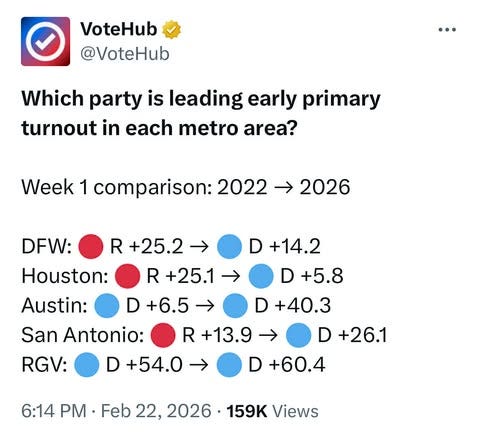
I don’t know how many seats Democrats (and Dem-leaning independents) will win in the Senate this year, but right now it seems clear that the Republicans have to spend money almost everywhere. Former Democratic Senator Jon Tester is supporting an independent candidate in Montana that may make that seat competitive. Alexander Vindman’s entry in the Florida Senate race may do the same. Even if Republicans win Texas handily in the end, it is likely not going to feel like that ahead of time and they will not be able to afford to ignore it. Iowa will be competitive along with Ohio and Nebraska. And Democrats should hold Georgia and New Hampshire. Maybe the final result in the Senate will remain 53-47 for the GOP when the dust clears, but they are going to have to fight hard for it, I think.
There are only five Senate races right now that we have enough polling data for the general election to create averages (* = incumbent):
Alaska:
Peltola (D): 46.9%
Sullivan* (R): 46.7%
New Hampshire:
Pappas (D): 47.3%
Sununu (R): 41.5%
North Carolina:
Cooper (D): 48.5%
Whatley (R): 34.8%
Nebraska:
Ricketts* (R): 49.3%
Osborn (I): 45.4%
Ohio:
Husted* (R): 47.3%
Brown (D): 47.2%
These are all bad numbers for Republicans. That said, while we have enough data to make averages here there is still not a lot of data. So take it all with a grain of salt.
Some recent Senate polls of interest in states without enough data for polling averages (because the primaries are competitive enough for the outcome to be highly uncertain right now):
Minnesota:
Flanagan (D): 47%
Tafoya (R): 41%
Michigan:
McMorrow (D): 46%
Rogers (R): 43%
Maine:
Platner (D): 44%
Collins* (R): 45%
None of these candidates are nominated at this point, FYI. They are hypothetical matchups. However, the races above that have polling averages are almost certainly going to be the matchups, with the exception of Alaska that has a top four ranked choice general election (but Peltola and Sullivan will make that cut).